
The Entrepreneur Series Tool
The Exponential Principles Canvas
The one-page strategic framework to structure, validate, and launch high-impact tech startups. Designed for technical professionals who keep their feet in the mud and their heads in the bits.
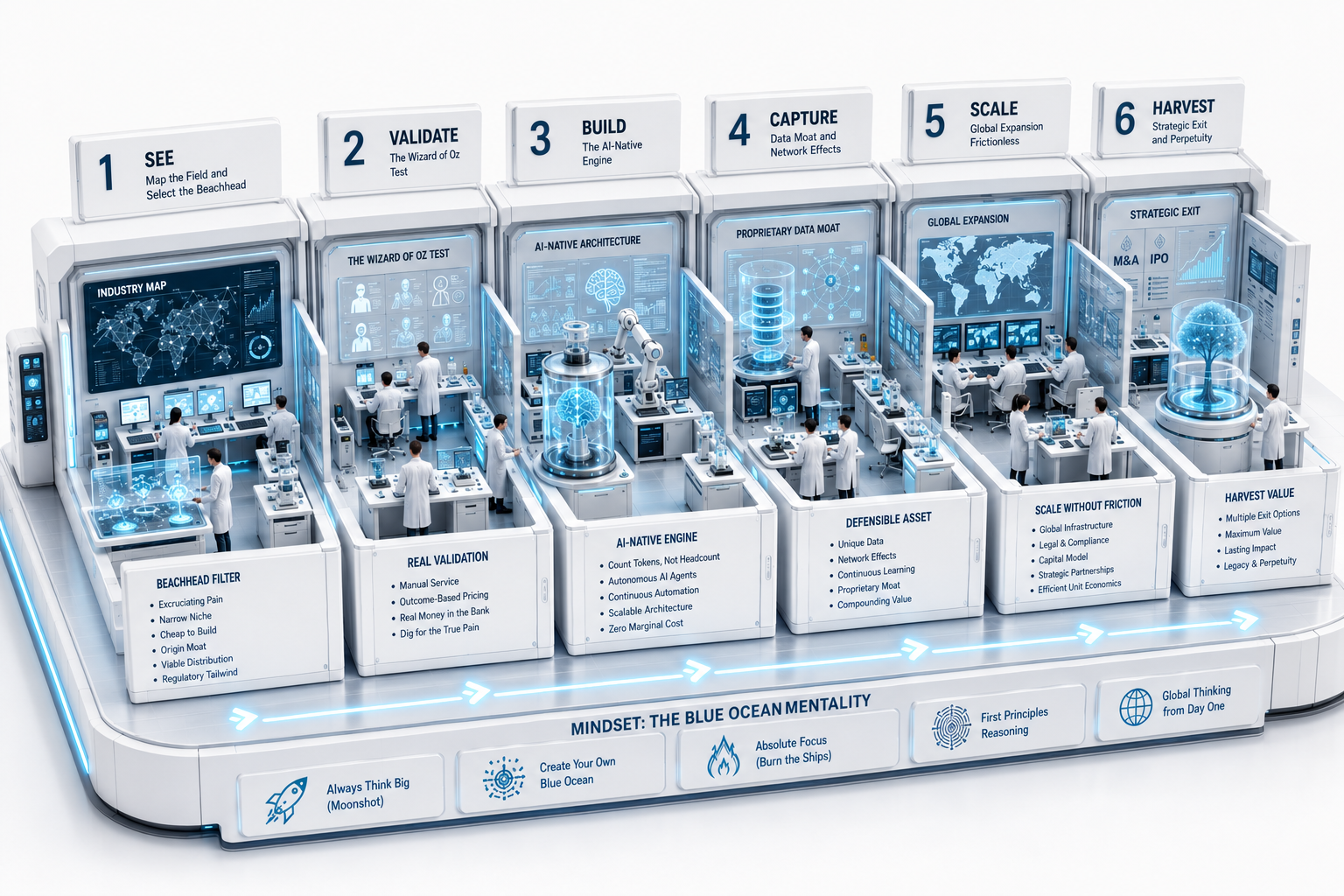
The Six Stations of the Method
Before building your interactive canvas below, we recommend watching this animated overview. It shows the operational dynamics: from capturing your domain knowledge in the Foundation, validating it manually with clients, orchestrating AI agent flows, and finally harvesting value in the exit.
Explore the 4 Dimensions of the Canvas
Click on each section to understand its key questions and see how real startups in the sector applied these principles to their models.
I. Mindset: The Blue Ocean Mindset
1. Think Big (Moonshot)
Flee from businesses with a technology expiration date. It takes the same effort to build a local linear startup as a global exponential startup.
2. Own Your Blue Ocean
Design a service or product that creates a new market where competition becomes irrelevant, avoiding price wars in red oceans.
3. Absolute Focus (Burn the Boats)
Eliminate exit strategies. Part-time work destroys the necessary speed of obsession; escape velocity requires 100% of your energy.
4. First Principles
Break down the industry into basic physical, biological, and economic truths. Rebuild the solution using AI instead of copying by analogy.
5. Global Thinking
Your market is global and local geography is your laboratory. Design the technical, legal, and operational architecture to cross borders without friction.
II. The Station-by-Station Method
Station 1: SEE (Data and Filters)
Digitalize the Atom: map physical processes as data bits. Apply the 6 filters to ensure an unbearable pain and a narrow beachhead.
Station 2: VALIDATE (The Manual Curtain)
Wizard of Oz: deliver the outcome manually 'behind the curtain'. Do not program anything until you collect payment; if you fail, dig into objections for the secondary pain.
Station 3: BUILD (Efficiency and PCE)
Write the Operations Dictionary. Use the Shadow Agent in draft mode before automating. Orchestrate agents with the Planner-Critic-Executor architecture.
Station 4: CAPTURE (Moats and Roles)
Binary Classification: Computing (100% AI) vs. Trust/Mud (100% Human). Appoint the Exception Orchestrator to audit and curate hallucinations.
Station 5: SCALE (VC & Compute)
Compute Funding: raise venture capital (VC) to scale servers and APIs, not headcounts. Maintain a concentrated Cap Table without excessive dilution.
Station 6: HARVEST (The Exit)
Exit by obsolescencia: design the exit by selling to threatened traditional dinosaurs in short windows (3-5 years) with pristine Due Diligence.
III. The Beachhead (6 Filters)
The entry niche must meet:
- 1. Unbearable Pain: daily and costly bottleneck.
- 2. Narrow Niche: easy to dominate in 1 week.
- 3. Cheap Build: no complex hardware at start.
- 4. Origin Moat: generates proprietary data from day 1.
- 5. Viable Distribution: Warm outbound, trusted access.
- 6. Regulatory Lego: rules help, do not hinder.
*A score lower than 4/6 indicates that you should continue narrowing or pivoting your niche hypothesis.
The Exponential Flywheel
The 6 stations are not a linear path that you walk just once. When executed with rigor, they trigger a self-reinforcing loop (Flywheel) that accelerates growth and deepens your moats with every transaction.
Validation in the Mud
Manual validation (Wizard of Oz) in a narrow beachhead generates immediate traction and your first dollars, capturing raw operational data directly from the field.
Compute Funding
Customer dollars (and later VC) are not burned on administrative salaries. They are reinvested in AI infrastructure, APIs, and vector databases.
Zero Marginal Cost
By delegating computation to autonomous agents (Planner-Critic-Executor), the cost of processing each new operational transaction tends to zero.
AI Refinement
Each transaction executed at zero cost refines the local AI engine by labeling proprietary contextual data, which is impossible to scrape from the public web.
Moat and Inevitability
The accumulation of proprietary data and the network effect (Industrial Waze) create a structural dependency: leaving the platform means going blind in the market.
The Value Harvest
The regional data monopoly and profitability attract scale and strategic buyers (threatened corporate dinosaurs), forcing the final liquidity event.
"The linearity of the canvas is for the founder; the circularity of the flywheel is for the market. Every customer interaction feeds the intelligence of your agents, deepening the moat and forcing the exit inevitably."
Complete your Canvas Online
Fill in the fields step-by-step. At the end, you can print your clean canvas or apply directly to the Startup Studio of The Entrepreneur Series.
EXPONENTIAL PRINCIPLES CANVAS
Completed online · www.serieemprendedor.com
Entrepreneur: —
Email: —
Area: —
Beachhead Score: —
I. The Foundation
1. Knowledge Asset (Fat Skills):
—
2. Red Line (Outcome Ownership):
—
II. The Field Method
Solution Hypothesis (SEE):
—
Wizard of Oz Test (VALIDATE):
—
Signal that someone pays:
—